
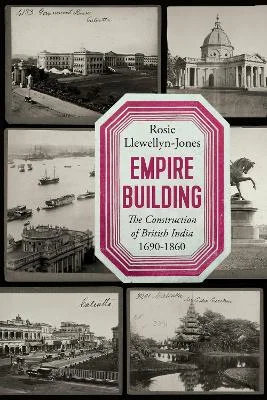
Description
By (author) Llewellyn-Jones Rosie
Short /annotation:
A richly illustrated history showing how the British Empire used buildings in early colonial India to influence attitudes among those who saw and used them.
:
”Empire Building” is a new account of the East India Company”s impact on India, focussing on how it changed the sub-continent”s built environment in the context of defence, urbanisation, and infrastructural development. Rosie Llewellyn-Jones examines these initiatives through a lens of ”political building” (using Indian contractors and labourers). Railways, docks, municipal buildings, freemasons” lodges, hotels, race-courses, barracks, cemeteries, statues, canals–everything the British erected made a political statement, even if unconsciously; hence this book is concerned less with architectural styles, more with subtle infiltration into the minds of those who saw and used these structures. It assesses, in turn, Indian responses to the changing landscape. Indians often reacted favourably to new manufacturing technologies from Britain, like minting and gunpowder, while the British learnt from and adapted local methods.From military engineers and cartography to imported raw metals and steam power, Llewellyn-Jones considers the social and environmental changes wrought by colonialism. This period was marked by a shift from formerly private, Indian-controlled functions, like education, entertainment, trading and healing, to British public institutions like universities, theatres, chambers of commerce and hospitals.
Review quote:
”A fascinatingly novel approach to studies of empire that is as illuminating as it is enjoyable.”
Review quote:
”With learning and dispassion, Llewellyn-Jones neither overplays the infrastructural legacy of the Raj nor, as is more often the case, does she excitedly tear it down.”
Review quote:
‘This book is concerned less with architectural styles, more with [the] subtle infiltration into the minds of those who saw and used these structures. It assesses, in turn, Indian responses to the changing landscape.’
Review quote:
‘In Empire Building, Rosie Llewellyn-Jones traces the history of Indian cartography during the British years.’
Review quote:
‘Although little remains of early Empire, other than the monumental buildings of the time, [Llewellyn-Jones] pulls together… intriguing stories out of the charred fragments.’
Review quote:
”Brick by brick, stone by stone, from canals to cantonments, Llewellyn-Jones masterfully reconstructs the infrastructure of empire in India. An engaging insight into a neglected area of imperial scholarship.”
Review quote:
‘Rosie Llewellyn-Jones should be read with attention, to get a sense of how negative perceptions can reduce, how empathy can enrich, how visual beauty can uplift, and how listlessness can destroy. It is a parable for today.’
Review quote:
”Highly readable, full of overlooked detail, Llewellyn-Jones brings British India to life.”
Review quote:
‘[Dr. Llewellyn Jones’] discussion and analysis are wide ranging in topic and time, both illuminating and fair.’
Review quote:
‘Rosie Llewellyn-Jones presents an impressive narrative of the link between political and economic activities of the EIC and the colonial built environment.’
Review quote:
‘This beautifully researched and written volume assesses the “political architecture” the British erected in India and how it impacted both the built environment and the people who used it. It is a major contribution to cultural histories of the British Empire in India.’
Review quote:
”This is a very readable book, richly illustrated, of interest to scholars and general readers alike.”
Review quote:
”Offbeat and absorbing, this co



Reviews
There are no reviews yet.